Clear, reliable sheet music storage helps musicians stay organized and ready for rehearsals and performances. This guide highlights five practical options ideal for different setups—solo practice, band rehearsals, and classroom use. Whether you need single-folder simplicity, expanded capacity, or durable, annotation-friendly pages, these picks cover common needs for piano players, choirs, orchestras, and instructors.
Summary table of selected products:
| Product | |||
|---|---|---|---|
| CRANBURY Sheet Music Folder (Black) | 48 sheets (24 sleeves) | Rehearsals and lessons | Lay-flat design for clear viewing |
| Ayfasnk Sheet Music Folder | Up to 60 sheets | Daily practice and performances | Index tabs and 180° lay-flat binding |
| VILLPORT Sheet Music Folder (20 sleeves) | 40 pages in 20 sleeves | Multi-instrumentalists and gigs | Top-and-bottom loading for easy annotation |
| MUDOR 4 Pages Expand Folder | Up to 60 pages | Performances with many pages | Expandable to 4 pages to reduce page turns |
| Musfunny Choral Sheet Music Binder | 80 pages (40 sheets) with 40 dual-use sleeves | Choir and large repertoires | Spiral binding with annotation-friendly design |
CRANBURY Sheet Music Folder Black
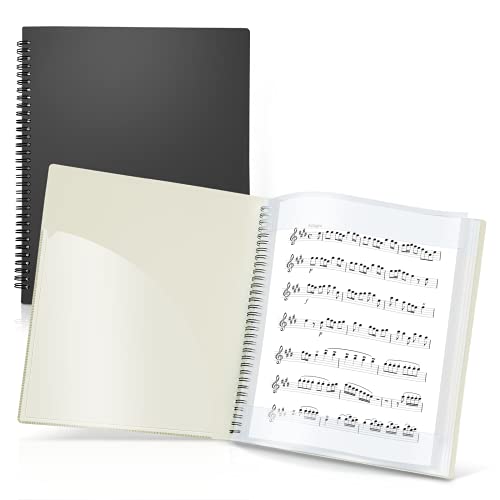
Includes 24 dual-use sleeves that display 48 letter-size sheets. The protective black cover features an embossed design with a white interior, while the back cover carries a subtle music motif for style. The folder is designed to lay flat on stands for clear viewing, keeping pages securely in place during rehearsals, performances, and lessons. Musically annotated pages stay readable thanks to retaining strips, making it a solid choice for band, orchestra, choir, and piano lessons.
Best for: Musicians who need a sturdy, affordable binder that stays open on stands and supports straightforward annotation during practice. Limitations: Some users may prefer larger capacity for concert programs.
Ayfasnk Sheet Music Folder

This folder holds up to 60 sheets of 8.5″ x 11″ music, aided by index tabs for quick labeling and a clip to prevent page shifting. The spiral binding folds 180 degrees for flat lay, enabling two-page spreads at once and reducing page turns during performances. It provides a clear display for direct annotation on the music, with secure top, side, and bottom closure to keep pages in place.
Best for: Players and conductors needing a higher-capacity option with easy page indexing. Limitations: Slightly heavier than compact binders, which may matter for travel use.
VILLPORT Sheet Music Folder

This 20-sleeve binder displays 40 pages of 8.5″ x 11″ scores. It features top-and-bottom loading strips that allow annotation directly on the music. The matte-finished plastic strips reduce glare for longer reading comfort, while the sturdy construction helps protect scores during frequent transport. It suits professional ensembles and teachers who require quick, reliable access to a full set of scores.
Best for: Musicians who need easy annotation without glare and reliable on-stand readability. Limitations: Fewer pages than some multi-folder systems, so plan for larger repertoires accordingly.
MUDOR 4 Pages Expand Folder

This folder expands to accommodate four pages at once, addressing page-turning challenges during performances. It holds up to 60 pages in total and is designed for easy insertion and removal of scores. The design minimizes glare and keeps single sheets from slipping off the stand, which helps maintain focus during performances.
Best for: Musicians who frequently handle longer scores and need to minimize page turns. Limitations: The expandability may be slightly more complex than single-page systems for beginners.
Musfunny Choral Sheet Music Binder

This binder offers 40 dual-use sleeves to display 80 pages, with a spiral binding that allows smooth page turning. The front and back covers include storage pockets, providing space for small extras. The hollow design of the sheet protector keeps the music clearly visible, and you can annotate directly on the score without removing it from the binder.
Best for: Choirs and large ensembles needing high capacity with easy annotation. Limitations: Spiral binding may be bulkier to carry at large venues.
Buying Guide: Sheet Music Storage Solutions
How much capacity do you actually need?
Consider your typical repertoire length. If you perform with multiple pieces per set, choose a folder with 40–60 pages or more. For daily practice, a medium capacity (40–80 pages) often suffices.
Is annotation important?
Look for folders that support direct annotation and minimize glare. Top-and-bottom loading strips or lay-flat designs help musicians write notes without removing sheets.
How portable should it be?
If you travel for gigs, prioritize lighter binders with secure closures and compact dimensions. For classroom use, larger folders with multiple sleeves may be preferable despite added weight.
Which features improve performance reliability?
Lay-flat ability, anti-slip page retention, and a sturdy cover protect scores on crowded stands. Annotation-friendly surfaces, such as matte finishes, reduce glare during performances.
Materials and durability
PP plastic, canvas, and coated covers offer durability for frequent transport. Consider water resistance for outdoor events or busy venues.
Which option suits different players?
- Beginners and students: simple, affordable folders with reliable page retention.
- Professional players: higher-capacity, annotation-friendly binders with durable construction.
- Choral or band leaders: larger, multi-page folders with easy organizer features.
Maintenance tips
Keep sleeves clean to preserve readability. Wipe down matte surfaces to prevent glare buildup. Replace worn sleeves to maintain page stability during performances.
Compact quick-reference comparison
- Best overall for versatility: Ayfasnk Sheet Music Folder
- Best for flat viewing and annotations: CRANBURY Black / CRANBURY Blue
- Best high capacity: Musfunny Choral Binder
- Best for minimizing page turns: MUDOR Expand Folder
- Best value for solo practice: VILLPORT 20-Sleeve Folder
Frequently asked questions
- What should I consider when choosing sheet music storage?
- Can I annotate directly on the music sheets?
- Are there sleeves that reduce glare?
- Is a larger binder always better?
- Which is best for choirs?
Capacity, annotation capability, and durability are key. Also consider how you transport the folder and typical performance settings.
Yes. Many folders are designed with top-and-bottom strips or lay-flat bindings that allow writing on the score without removing it.
Yes. Matte-finished strips and non-glare pages help reduce reflections, especially under stage lighting.
Not necessarily. A larger binder increases capacity but may be heavier and bulkier to carry. Match size to usage needs.
Choir-focused options typically emphasize high capacity, durable sleeves, and easy annotation across many pages, such as the Musfunny Choral Binder.