Looking for a kid-friendly wall clock that teaches time and complements a child’s room? This guide highlights five top options that are easy to read, quiet, and engaging for children. Each clock is selected to suit different learning needs and room styles, from classroom-ready designs to home decor clocks. Use the quick comparison table below to pick the best match for your child’s age and setting.
| Product | Best For | Key Benefit | Notable Limitation |
|---|---|---|---|
| Lantoo Silent Kids Wall Clock | Young learners and quiet rooms | Non-ticking, colorful yet simple design | 8 inch size may be small in larger rooms |
| Oyster&Pop Kids Wall Clock (10″) | Classrooms and playrooms | Color-coded hands with labeled minutes | Wood-effect frame may clash with modern minimal decor |
| Roymnie Wall Clock for Kids | Hands-on teaching at home | Colorful face with clearly labeled minutes | 8 inch may be compact for large walls |
| Oyster&Pop Rainbow Kids Wall Clock (10″) | Creative classrooms and bedrooms | Rainbow design with silent operation | Colorful design may distract some learners |
| Mabpedo Colorful Teaching Wall Clock (8″) | Homeschool and small classrooms | Vibrant color-coding and clear markings | Battery not included; small size |
Lantoo Silent Kids Wall Clock

The Lantoo clock uses a silent, high-quality sweep movement to deliver true quiet operation, ideal for bedrooms or study areas. It features a white frame with colorful numerals and hands that are easy for children to read without being distracting. This clock is best for younger kids learning to tell time or for spaces where noise could interrupt focus. A potential limitation is that the 8-inch size may feel small on larger walls.
Oyster&Pop Kids Wall Clock

This 10″ analog clock helps kids learn to tell time with minute and hour hands labeled and color-coded. It is truly silent, thanks to a smooth sweeping movement, making it suitable for nap times and study sessions. The wood-effect frame and bright colors work well in classrooms or kid bedrooms. Choose this if you want clear time-reading cues and a simple, sturdy design; avoid if a more modern or minimalist frame is preferred.
Roymnie Wall Clock for Kids

The Roymnie 8″ clock emphasizes a color-coded, easy-to-read face designed for teaching time. Its silent, non-ticking motion supports quiet rooms, bedrooms, or study spaces. The compact size makes it a practical fit for smaller walls or deskside displays. A limitation to note is the smaller dial, which may be harder to read from across a larger room.
Oyster&Pop Rainbow Kids Wall Clock

This 10″ rainbow-design clock combines color-coded time-reading cues with a silent, smooth movement. It works well in creative classrooms or a child’s playroom, where visual appeal supports engagement with time concepts. Use this when you want a playful decor element that doubles as a teaching tool; if a neutral look is needed, another option may be preferable.
Mabpedo Colorful Teaching Wall Clock
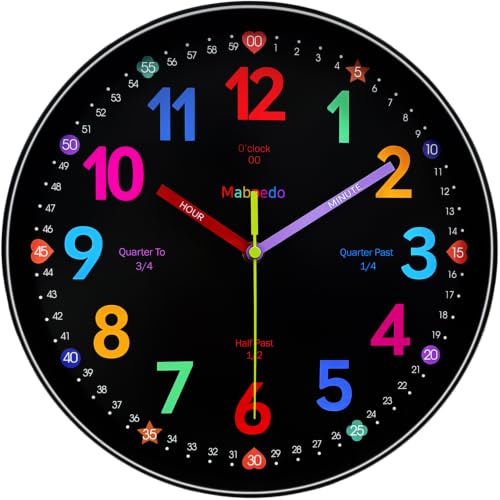
This 8″ Mabpedo clock uses vibrant numerals and distinct hands to aid time-telling practice. Its colorful dial supports visual learning in homeschool settings or small classrooms. It runs on battery power and offers a non-ticking experience, making it suitable for bedrooms or study corners. A potential limitation is the smaller display area which may not suit larger classrooms.
Buying Guide
What should you consider when choosing a kids’ wall clock?
- Size and visibility: Pick a clock with large numbers and contrasting hands. For classrooms or playrooms, 10″–12″ clocks are typically easier to read from a distance.
- Movement and noise: Prefer a non-ticking or sweep movement for quiet environments like bedrooms, libraries, or naptime spaces.
- Color coding and labeling: Color-coded numerals and labeled minute marks help children associate numbers with time concepts more quickly.
- Frame style and room decor: Choose a design that complements the room — bright, playful clocks for kids’ rooms and more neutral frames for shared spaces.
- Power source: Most operate on a single AA battery. Check whether batteries are included or need to be purchased separately.
- Durability and ease of installation: Look for simple mounting options and durable materials for active kids’ rooms or classrooms.
Practical Buying Questions
- Which clock is best for a quiet bedroom? A model with a true silent or sweep movement, like the Lantoo or Oyster&Pop options, minimizes ticking sounds.
- What if my wall is large? Choose a 10″–12″ clock with clear numerals and visible hands for easy reading from across the room.
- Are color-coded clocks better for kids? Yes, color-coding on numbers and hands can reinforce time-telling concepts and attention to detail.
- Should I prioritize a decorative frame or a plain one? If time-telling is the primary goal, prioritize readability; if the clock doubles as decor, select a frame that fits the room’s theme.
- Do these clocks include batteries? Some do not; verify battery inclusion before purchase to avoid a separate trip to the store.
FAQ
- What is the main benefit of a silent wall clock for kids? It reduces distractions during study and sleep, supporting focus on telling time.
- Are these clocks suitable for classrooms? Yes, several models are designed with classroom teaching in mind, offering easy-to-read faces and durable construction.
- Can these clocks help with early time-telling skills? Absolutely; color coding and labeled minutes help children grasp hour and minute concepts quickly.
- Is a smaller clock okay for a large wall? It can be, but readability may suffer. Consider 10″–12″ clocks for better visibility in bigger spaces.
- Do these clocks require special maintenance? Routine battery replacement is typically sufficient; non-ticking mechanisms require minimal care beyond standard dusting.