Looking for clocks with movable hands that help kids learn to tell time? This guide highlights five kid-friendly clocks designed to build time-telling skills through hands-on practice. The chosen models suit classroom use, homeschool learning, and independent practice. Best for teachers demonstrating time concepts, parents guiding early learners, and tutors reinforcing time-telling basics. A quick reference table follows to compare core features at a glance.
| Product | Best For | Key Benefit | Limitations |
|---|---|---|---|
| Learning Resources Big Time Mini Clock | Preschool to early elementary | Hidden gears keep correct time as you spin hands | Small size may be ideal for individual practice |
| Learning Resources Time Activity Set | Classrooms and group work | Realistic analog with moving hands for practice | Requires space for full set |
| Scribbledo Learning Clock for Kids 13″ | Homeschool and classroom | Analog and digital display, dry erase surface | Two-in-one format may require student adaptation |
| Learning Resources Big Time Student Clock | Demonstrations & guided lessons | Judy clock mechanism supports hour advancement | Primarily demonstration-focused |
| Learning Resources Write & Wipe Demonstration Clock | Classrooms and tutoring | Large analog face with write-and-wipe practice | Requires dry-erase maintenance |
Learning Resources Big Time Mini Clock

The Learning Resources Big Time Mini Clock helps early learners practice telling time with movable hands. Its hands are color-coded to match the hour and minute markings, aiding quick association between clock positions and time readings. The clock’s hidden gears help maintain accurate time as you manipulate the hands, supporting active exploration without constant resets. Best for young students new to time concepts and parents seeking a compact, classroom-friendly teaching tool.
Who it’s best for: Preschool to early elementary students who benefit from color-coded cues and hands-on manipulation. Teachers introducing hours and minutes will find this a straightforward demonstration tool.
Why chosen: It combines tactile practice with visual cues, encouraging independent exploration while reinforcing correct hand relationships. A potential limitation is its compact size, which is ideal for individual use but may require supplementary larger clocks for whole-class demonstrations.
Learning Resources Time Activity Set
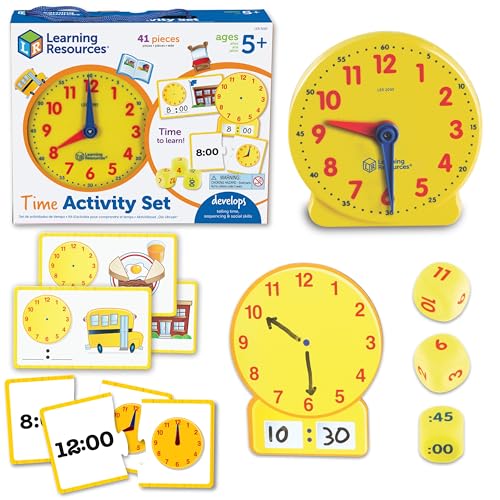
The Time Activity Set provides a realistic analog clock with moving hour and minute hands, designed to build precise time-telling skills through hands-on practice. It supports classroom use, small-group activities, and guided practice, helping students identify hours and half-hours. The set is durable and classroom-ready, making it a solid fit for schools and homeschool environments that emphasize practice with real-world clocks.
Who it’s best for: Teachers and tutors conducting structured lessons or small-group time-telling exercises, as well as parents facilitating classroom-style activities at home.
Why chosen: The product focuses on practical time-reading steps and adaptable use in different instructional formats. A potential limitation is that large, ongoing activities may require multiple sets or extra clocks for whole-class tasks.
Scribbledo Learning Clock for Kids 13″
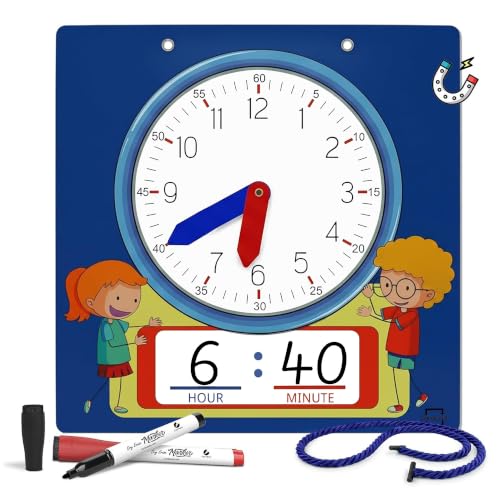
The Scribbledo clock blends analog and digital time teaching. It presents the classic movable red hour hand and blue minute hand with color-coded markers, and adds a dry erase digital display below for simultaneous practice. This two-in-one approach helps students connect analog and digital times, accelerating understanding. Best for learners who benefit from switching between formats and for teachers who want to demonstrate both representations in one device.
Who it’s best for: Students who benefit from dual-format practice and teachers seeking a versatile teaching tool. A limitation is the need for ongoing dry-erase maintenance and marker supplies.
Learning Resources Big Time Student Clock

The Big Time Student Clock is designed for demonstrations and guided practice. It features a Judy mechanism where the hour hand automatically advances as the minute hand is moved, helping students see the relationship between hours and minutes in real time. It’s well-suited for classroom demonstrations and teacher-led explanations, providing a reliable reference during lessons.
Who it’s best for: Instructors delivering live lessons and students needing a clear, visible demonstration of hour-minute progression. Caution: primarily a demonstration clock, so students may require another device for independent practice.
Learning Resources Write & Wipe Demonstration Clock

The Write & Wipe Demonstration Clock combines a large analog clock with a dry erase surface for digital time practice. Students can read the analog hands and then write the corresponding digital time on the surface, enabling quick checks and repeatable practice without paper waste. Ideal for lessons that integrate both formats and ongoing assessment in a classroom setting.
Who it’s best for: Classrooms and tutoring scenarios focusing on simultaneous analog and digital time understanding. Limitation: requires dry erase markers and occasional erasing for reuse.
Buying Guide
What should you consider when choosing a clock with movable hands?
- For preschoolers, compact clocks with color-coded hands help new learners. For early elementary students, clocks offering both analog and digital practice support gradual mastery.
- Do you want a strictly analog clock, or a combined analog-digital configuration? Two-in-one formats can speed understanding but may require more setup.
- Demonstration clocks are excellent for guided lessons, while dry-erase clocks support independent practice and ongoing assessment.
- Look for durable materials, readable numbers, and hands that move smoothly under repeated use.
- Dry-erase surfaces require cleaning; gear mechanisms should operate reliably with frequent use.
- Classrooms may need multiple clocks or a larger display clock for whole-class instruction.
Frequently Asked Questions
- What age is best for clocks with movable hands? Suitability typically starts around ages 4–6 for basic concepts, with more advanced practice appropriate through 7–9 years old as time-reading skills grow.
- Are two-in-one analog-digital clocks better for beginners? They can be; they help connect readings on both formats, reinforcing understanding but may require more setup and guidance.
- Should I choose a classroom set or single clocks? Classroom sets are ideal for group activities, while single clocks work well for individual practice or station rotations.
- What features improve practice effectiveness? Color-coded hands, visible markings, and the ability to move hands smoothly are key for quick recognition and hands-on learning.
- Are dry-erase clocks reusable for many lessons? Yes, dry-erase surfaces support repeated practice, just be sure to stock markers and clean between activities.
- Is a clock with automatic hour advancement helpful? It helps illustrate how the hour hand tracks minute changes during demonstrations, supporting concept retention.