The best budget and bill organizer depends on how you manage money: the Taja Budget Planner suits people who want monthly planning and tracking in one book, while the cash-envelope options are better for organizing physical cash. The KMQOY planner is identified as an undated 12-month organizer, and the Bill Tracker Notebook focuses on monthly payment checklists. Compare the formats below to find one that fits your routine.
| Product | Best suited for | Format |
|---|---|---|
| Taja Budget Planner | All-in-one monthly planning | Undated budget book |
| KMQOY Budget Planner | Undated yearly organization | 12-month money organizer |
| Black Cash Envelope Wallet | Separating cash by category | Portable wallet with dividers |
| Budget Binder with Zipper Envelopes | Cash stuffing and flexible storage | A6 ring binder |
| Bill Tracker Notebook | Recording monthly bill payments | Checklist notebook |
Taja Budget Planner
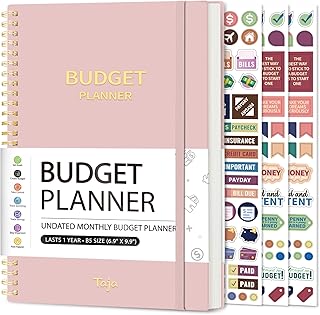
Best for: People who want monthly budgeting, bill reminders, savings goals, and expense tracking in one undated book. It was selected because the listed layout covers several common budgeting tasks rather than bill payments alone.
The planner includes monthly pages for setting goals, recording income, and planning expenses. Additional sections are described for debt tracking, savings goals, and bill payments. Its undated monthly calendar provides space for users to write in paydays, due dates, appointments, and other important dates. Three sticker sheets are also included.
Limitation: Dates are not pre-printed, so users need to fill them in. Choose another format if you prefer a ready-dated planner or a wallet for carrying cash.
KMQOY Undated Budget Planner

Best for: Buyers looking for an undated planner described as a 12-month money organizer with an expense tracker. Its stated format makes it a candidate for people who want to organize a year of budgeting without relying on pre-printed dates.
The product name identifies it as a budget planner with an expense tracker and a 12-month structure. Those details distinguish it from a bill-only checklist and from physical cash organizers.
Limitation: The available product information does not specify its page layout, extra tracking sections, or included accessories. Check the listing details to confirm that its pages cover the categories you need.
Black Cash Envelope Wallet

Best for: People who use cash categories and want a compact wallet to separate money while on the go. It was selected for its six frosted cash-envelope pockets and month-label stickers, which support dividing funds by category.
The listing describes a plastic wallet with reusable, tear-resistant dividers. The pockets can hold cash and other small paper items, including receipts, bills, checks, and coupons. Its lightweight design is described as suitable for carrying in a bag or pocket.
Limitation: This is a physical cash organizer, not a full monthly budget book. Choose a planner as well if you need dedicated pages for income, expenses, or savings goals.
Budget Binder With Zipper Envelopes

Best for: Cash-stuffing users who want a refillable binder with labeled categories and extra storage. It was selected because the set combines zipper envelopes, budget sheets, and removable ring pages.
The A6 binder includes eight cash zipper envelopes, 12 budget sheets, category stickers, labels, and two storage bags. Its six refillable rings allow sheets and envelopes to be added or removed. The cover also has card slots, pen loops, and side pockets, according to the product details.
Limitation: This format is centered on cash and compact paper organization. Its A6 size may not suit someone who wants larger pages for extensive written notes.
Monthly Bill Tracker Notebook

Best for: People whose main goal is maintaining a monthly bill-payment checklist. The product title identifies it as a bill tracker notebook with more than 100 pages and an 8.5-by-11-inch format.
This option is more focused than a comprehensive budget planner. It may suit users who want a notebook dedicated to monitoring bill payments, rather than combining bills with cash envelopes or broader money planning.
Limitation: The available product details do not describe specific page fields or additional budgeting sections. Confirm the interior layout if you need to track income, savings, or spending categories too.
Buying Guide: How To Choose A Budget And Bill Organizer
Do you need a planner, a wallet, or both?
Choose a budget book if you want written sections for income, expenses, goals, and bills. A cash-envelope wallet is better for physically separating spending money. A binder combines cash pockets with removable sheets, while a bill tracker focuses on payment checklists. Some people may prefer a planner and a cash organizer together, but the formats serve different tasks.
Should you choose an undated planner?
An undated planner lets you fill in dates yourself, which may suit users who start budgeting at different times or want flexibility. It also requires more setup. Before choosing, check whether the product includes the tracking sections you need, such as bills, savings, debt, or expense records.
How important is portability?
For carrying physical cash, compare the wallet or binder format and the number of pockets or envelopes. The Black Cash Envelope Wallet is described as compact and lightweight, while the A6 binder offers rings, zipper envelopes, and additional storage. A larger notebook may be more appropriate for writing space but less convenient to carry.
What should you check before buying?
- Tracking needs: Decide whether you need bill payments only or a broader budget system.
- Organization style: Select paper pages, cash dividers, or a refillable binder based on how you manage money.
- Date setup: Confirm whether dates are pre-printed or must be entered by hand.
- Included components: Check the listed number of envelopes, pages, dividers, or stickers when those items matter to you.
Frequently Asked Questions
What is the difference between a budget planner and a bill tracker?
A budget planner can organize income, expenses, savings, and goals. A bill tracker is focused on recording or checking off bill payments.
Are cash envelope organizers useful without a planner?
They can help separate physical cash by spending category. They do not replace written income or expense planning unless those tasks are tracked separately.
What does undated mean in a budget planner?
Undated means the user fills in calendar dates rather than relying on pre-printed dates. The Taja planner specifically describes an undated monthly calendar.
Which option is best for cash stuffing?
The cash wallet and zipper-envelope binder are the most directly suited to cash stuffing because their listed features include separate cash pockets or envelopes.
Which organizer is best for tracking bills only?
The Bill Tracker Notebook is the most focused choice based on its title, which describes a monthly bill payment checklist.